Loại bỏ dị vật giác mạc bằng nhựa ở trẻ nhũ nhi 2 tháng tuổi: Báo cáo ca lâm sàng
Plastic Corneal Foreign Body Removal From a 2-Month-Old Infant: A Case Report
Abstract
Tóm tắt
BACKGROUND: Infantile corneal foreign bodies (CFBs) are rare and frequently result in delayed diagnoses and treatment challenges. This report describes a case of a very young infant with a small plastic CFB that was successfully removed.
BỐI CẢNH: Dị vật giác mạc (CFB) ở trẻ nhũ nhi là trường hợp hiếm gặp, thường dẫn đến việc chẩn đoán muộn và gặp nhiều thách thức trong điều trị. Báo cáo này mô tả một trường hợp trẻ nhũ nhi còn rất nhỏ có một dị vật giác mạc bằng nhựa kích thước nhỏ đã được loại bỏ thành công.
CASE REPORT: A 2-month-old boy was observed to have a “small dot” foreign body on his left cornea by his parents. No crying response to the CFB or other symptoms had ever been identified. Slit lamp examination revealed the presence of a small, oval, plastic foreign body in the corneal epithelial layer. This CFB was determined to be an ornament affixed to the dress that the babysitter was wearing at the time. For CFB removal, medical sedation was rejected by the infant’s guardian. The initial attempt to flush the CFB out with saline or extract the CFB using a cotton-tipped applicator alone proved unsuccessful. Subsequent release of the CFB from the cornea was facilitated by the addition of proparacaine hydrochloride drops to the conjunctival sac and the use of a 1-mL needle, which was then adhered to the cotton-tipped applicator, thereby enabling its removal.
BÁO CÁO CA LÂM SÀNG: Một bé trai 2 tháng tuổi được cha mẹ phát hiện có một dị vật dạng “chấm nhỏ” trên giác mạc mắt trái. Không ghi nhận phản ứng khóc đối với dị vật giác mạc hoặc bất kỳ triệu chứng nào khác trước đó. Khám bằng đèn khe cho thấy sự hiện diện của một dị vật nhỏ, hình bầu dục, bằng nhựa nằm trong lớp biểu mô giác mạc. Dị vật giác mạc này được xác định là một họa tiết trang trí đính trên chiếc váy mà người trông trẻ đang mặc vào thời điểm đó. Để loại bỏ dị vật giác mạc, người giám hộ của trẻ đã từ chối phương pháp an thần y tế. Nỗ lực ban đầu nhằm rửa trôi dị vật giác mạc bằng nước muối sinh lý hoặc chỉ dùng tăm bông để lấy dị vật ra đều không thành công. Việc tách dị vật giác mạc ra khỏi giác mạc sau đó đã được hỗ trợ bằng cách nhỏ thêm thuốc nhỏ mắt proparacaine hydrochloride vào cùng đồ kết mạc và sử dụng một đầu kim 1-mL, sau đó dị vật dính vào tăm bông, nhờ đó có thể lấy nó ra thành công.
CFBs in young infants may not manifest any symptoms and thus can be easily ignored. The removal of plastic CFBs in those young infants who exhibit limited communication and cooperation abilities remains a challenging procedure. This report proposes a viable and low-risk, office-based approach to address the issue of CFB removal in infants.
Dị vật giác mạc ở trẻ nhũ nhi có thể không biểu hiện bất kỳ triệu chứng nào và do đó dễ bị bỏ qua. Việc loại bỏ các dị vật giác mạc bằng nhựa ở những trẻ nhỏ này—vốn là đối tượng có khả năng giao tiếp và hợp tác hạn chế—vẫn là một thủ thuật đầy thách thức. Báo cáo này đề xuất một phương pháp khả thi, ít rủi ro và có thể thực hiện ngay tại phòng khám để giải quyết vấn đề loại bỏ dị vật giác mạc ở trẻ nhũ nhi.
Keywords: emergency medicine, ophthalmology, pediatrics, traumatology
Từ khóa: y học cấp cứu, nhãn khoa, nhi khoa, chấn thương học
Introduction
Đặt vấn đề
Corneal foreign bodies (CFBs) are a prevalent cause of ocular trauma, often regarded as an occupational hazard 1. Approximately 8% of emergency department visits are due to eye trauma, with 31% of these cases involving CFBs 2. Symptoms of a CFB often include pain, foreign body sensation, tearing, and/or bulbar redness 3. CFBs can result from environmental exposure or accidental trauma, with dust, metal shavings, and organic matter being common sources, and the incidence of plastic orbital foreign body has recently increased 4. Moreover, CFBs in young children are increasingly concerning due to the vulnerability of their developing ocular structures and the challenges in communicating symptoms 5–7.
Dị vật giác mạc (CFB) là một nguyên nhân phổ biến gây chấn thương mắt, thường được xem là một tai nạn lao động 1. Khoảng 8% các ca đến khám tại khoa cấp cứu là do chấn thương mắt, trong đó có 31% trường hợp liên quan đến dị vật giác mạc 2. Các triệu chứng của dị vật giác mạc thường bao gồm đau, cảm giác cộm xốn như có dị vật, chảy nước mắt, và/hoặc đỏ cương tụ kết mạc 3. Dị vật giác mạc có thể bắt nguồn từ việc tiếp xúc với môi trường hoặc chấn thương do tai nạn, với các nguồn phổ biến là bụi, mạt kim loại và chất hữu cơ, và tỷ lệ dị vật hốc mắt bằng nhựa gần đây đã gia tăng 4. Hơn nữa, dị vật giác mạc ở trẻ nhỏ ngày càng đáng lo ngại do cấu trúc mắt đang phát triển của trẻ rất dễ bị tổn thương và những thách thức trong việc biểu đạt các triệu chứng 5–7.
Despite the abundance of literature on this subject and its relatively straightforward diagnosis 8–10, CFBs can be initially overlooked, particularly in young infants. In addition, treating CFBs in infants frequently poses challenging. This report describes the case of a 2-month-old boy with a small plastic CFB successfully removed by needle extraction.
Mặc dù có rất nhiều tài liệu về chủ đề này và việc chẩn đoán tương đối đơn giản 8–10, dị vật giác mạc ban đầu vẫn có thể bị bỏ sót, đặc biệt là ở trẻ nhũ nhi. Ngoài ra, việc điều trị dị vật giác mạc ở trẻ nhũ nhi thường gặp nhiều thách thức. Báo cáo này mô tả trường hợp một bé trai 2 tháng tuổi có dị vật giác mạc bằng nhựa kích thước nhỏ được loại bỏ thành công bằng phương pháp dùng kim lấy dị vật.
Case Report
Báo cáo ca lâm sàng
A 2-month-old boy was admitted to the outpatient clinic of our hospital. His parents reported that a “small dot” had been observed at his left cornea for 3 days. The infant was burping on the babysitter’s shoulder when this “dot” was first found. His parents and babysitter declared that no inconsolable crying or other abnormalities have occurred during the 3 days. In addition, the infant was born at full term, with no history of other illnesses, and had not been found to have rubbed his eyes.
Một bé trai 2 tháng tuổi được nhận vào khoa khám bệnh ngoại trú của bệnh viện chúng tôi. Cha mẹ bé báo cáo rằng đã quan sát thấy một “chấm nhỏ” trên giác mạc mắt trái của bé được 3 ngày. Trẻ đang ợ hơi trên vai người trông trẻ khi “chấm nhỏ” này lần đầu tiên được phát hiện. Cha mẹ và người trông trẻ của bé khẳng định rằng không có tình trạng khóc dỗ không nín hoặc các bất thường khác xảy ra trong suốt 3 ngày qua. Ngoài ra, trẻ sinh đủ tháng, không có tiền sử mắc các bệnh lý khác, và không phát hiện thấy trẻ dụi mắt.
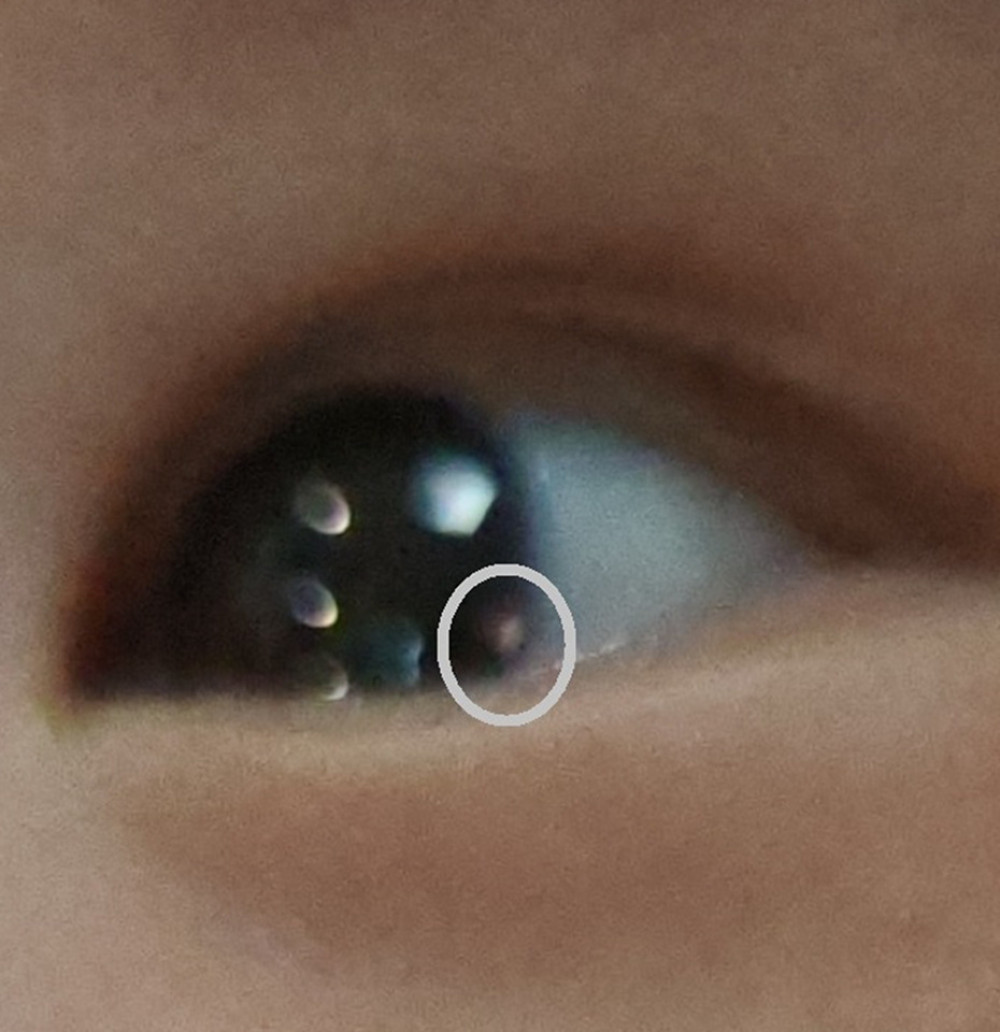
Portable slit lamp examination revealed an oval, pink, plastic foreign body in the epithelial layer of the cornea near his inferior-temporal limbus, with a diameter of approximately 0.8 mm. No evidence of bulbar redness or refractory media opacity was observed (Figure 1). The family members’ recollection suggested that the foreign body was determined to be an ornament affixed to the dress that the babysitter was wearing at the time.
Khám bằng đèn khe xách tay cho thấy một dị vật bằng nhựa, màu hồng, hình bầu dục nằm ở lớp biểu mô của giác mạc gần vùng rìa phía dưới – thái dương, với đường kính khoảng 0.8 mm. Không quan sát thấy dấu hiệu đỏ cương tụ kết mạc hay đục các môi trường trong suốt (Hình 1). Trí nhớ của các thành viên trong gia đình gợi ý rằng dị vật được xác định là một họa tiết trang trí đính trên chiếc váy mà người trông trẻ đang mặc vào thời điểm đó.
With the consent of the infant’s guardian (his mother), the infant was placed on a treatment bed, and topical anesthesia was administered using 0.5% proparacaine hydrochloride eye drops (Alcon Inc), followed by CFB removal. Sedation with chloral hydrate oral solution was rejected by the guardian. Considering the infant’s limited ability to cooperate, we initially attempted to remove the foreign body by flushing it out with saline, and failed. Then, we tried CFB removal by using a sterile cotton-tipped applicator, but also encountered difficulty due to its firm adhesion to the cornea. Subsequently, we directed the assistant to stabilize the infant’s head position. Thereafter, we re-administered proparacaine hydrochloride drops to the conjunctival sac and meticulously released the foreign body from the cornea with a 1-mL needle (26 gauge) tip while the eye drops remained on the surface of the conjunctival sac and cornea. We then expeditiously removed the CFB using a sterile cotton-tipped applicator. After removal of the CFB, the infant’s ocular surface appearance showed no obvious abnormality. Topical administration of 0.3% tobramycin eye drops (Alcon) were used to prevent infection. No bulbar redness, corneal opacities, infection, or adverse effects were found during the 3-day and 1-week follow-ups. The patient’s parents were satisfied with the treatment.
Được sự đồng ý của người giám hộ của trẻ (mẹ bé), trẻ được đặt nằm trên giường điều trị, và tiến hành gây tê bề mặt bằng thuốc nhỏ mắt proparacaine hydrochloride 0.5% (Alcon Inc), sau đó là loại bỏ dị vật giác mạc. Việc gây mê bằng dung dịch uống chloral hydrate đã bị người giám hộ từ chối. Kế đến, chúng tôi cố gắng loại bỏ dị vật bằng cách sử dụng tăm bông vô trùng, nhưng cũng gặp khó khăn do dị vật bám dính chắc vào giác mạc. Tiếp theo, chúng tôi hướng dẫn người trợ lý cố định tư thế đầu của trẻ. Sau đó, chúng tôi nhỏ lại thuốc nhỏ proparacaine hydrochloride vào cùng đồ kết mạc và tỉ mỉ tách dị vật ra khỏi giác mạc bằng đầu kim 1-mL (26 gauge) trong khi thuốc nhỏ mắt vẫn còn trên bề mặt cùng đồ kết mạc và giác mạc. Sau đó, chúng tôi nhanh chóng lấy dị vật giác mạc ra bằng tăm bông vô trùng. Sau khi loại bỏ dị vật giác mạc, bề mặt nhãn cầu của trẻ cho thấy không có bất thường rõ ràng nào. Sử dụng thuốc nhỏ mắt tobramycin 0.3% (Alcon) đường tại chỗ để phòng ngừa nhiễm trùng. Không tìm thấy tình trạng đỏ cương tụ kết mạc, đục giác mạc, nhiễm trùng hoặc tác dụng phụ nào trong các lần tái khám sau 3 ngày và 1 tuần. Cha mẹ của bệnh nhi hài lòng với quá trình điều trị.
Discussion
Bàn luận
This case report demonstrates the absence of significant symptoms of a plastic CFB in a young infant, highlighting the importance of comprehensive parental care. Also, a viable and low-risk office-based approach to address the issue of CFB removal in young infants is indicated.
Báo cáo ca lâm sàng này cho thấy sự vắng mặt của các triệu chứng rõ rệt đối với dị vật giác mạc bằng nhựa ở trẻ nhũ nhi, nhấn mạnh tầm quan trọng của việc chăm sóc toàn diện từ cha mẹ. Đồng thời, một phương pháp khả thi, ít rủi ro và có thể thực hiện ngay tại phòng khám để giải quyết vấn đề loại bỏ dị vật giác mạc ở trẻ nhỏ cũng được chỉ ra.
For many years, cases of CFB injury were classified as minor ocular trauma 8, as the condition generally did not result in severe complications if the removal procedure was performed promptly. However, if the CFB is ignored or removal is delayed, it can lead to keratitis or even endophthalmitis. Furthermore, in the case of children, particularly infants, failure to remove or delaying the removal of CFB can result in astigmatism or amblyopia, which can have a detrimental impact on their lifelong visual quality 11.
Trong nhiều năm qua, các trường hợp chấn thương do dị vật giác mạc được phân loại là chấn thương mắt nhẹ 8, vì tình trạng này nhìn chung không dẫn đến các biến chứng nghiêm trọng nếu thủ thuật loại bỏ được thực hiện kịp thời. Tuy nhiên, nếu dị vật giác mạc bị bỏ qua hoặc việc loại bỏ bị trì hoãn, nó có thể dẫn đến viêm giác mạc hoặc thậm chí là viêm nội nhãn. Hơn nữa, trong trường hợp của trẻ em, đặc biệt là trẻ nhũ nhi, việc không loại bỏ hoặc chậm trễ loại bỏ dị vật giác mạc có thể dẫn đến loạn thị hoặc nhược thị, điều này có thể gây ảnh hưởng bất lợi đến chất lượng thị giác suốt đời của trẻ 11.
Previous case reports have described metallic CFBs in children, often presenting with pronounced symptoms such as foreign body sensation and conjunctival redness 5,7,12. In contrast, the patient in our case presented no symptoms, suggesting the uniqueness of small plastic CFBs and the young age of occurrence. Therefore, a thorough and timely examination is critical for CFBs of materials such as plastic 4 and for young patients. Given the infant’s limited cooperation and, in this case, the parents’ refusal of medical sedation, performing a thorough slit lamp examination and fluorescein dye was challenging. Such examinations are, however, essential for most cases of CFB 2,3. Therefore, a comprehensive clinical history obtained from parents and/or all relevant individuals regarding risk factors and exposure is of paramount importance. Also, it is important to acknowledge the significance of ruling out open-globe injuries 13, although such injuries were not observed in this case.
Các báo cáo ca lâm sàng trước đây đã mô tả dị vật giác mạc bằng kim loại ở trẻ em, thường biểu hiện với các triệu chứng rõ rệt như cảm giác cộm xốn và đỏ kết mạc 5,7,12. Ngược lại, bệnh nhi trong trường hợp của chúng tôi không xuất hiện triệu chứng nào, gợi ý về tính chất đặc thù của các dị vật giác mạc bằng nhựa kích thước nhỏ và độ tuổi khởi phát còn rất nhỏ. Do đó, việc thăm khám kỹ lưỡng và kịp thời là vô cùng quan trọng đối với các dị vật làm bằng chất liệu như nhựa 4 và đối với các bệnh nhi nhỏ tuổi. Do sự hợp tác hạn chế của trẻ nhũ nhi và trong trường hợp này là sự từ chối an thần y tế của cha mẹ, việc thực hiện kiểm tra kỹ lưỡng bằng đèn khe và nhuộm fluorescein là một thách thức. Tuy nhiên, các hình thức thăm khám như vậy lại là thiết yếu đối với hầu hết các trường hợp dị vật giác mạc 2,3. Vì vậy, việc khai thác tiền sử lâm sàng toàn diện từ cha mẹ và/hoặc tất cả những người liên quan về các yếu tố nguy cơ và sự tiếp xúc là điều tối quan trọng. Ngoài ra, việc nhận thức được tầm quan trọng của việc loại trừ chấn thương xuyên nhãn cầu 13 cũng rất cần thiết, mặc dù những chấn thương như vậy không được ghi nhận trong trường hợp này.
Despite the long-standing recognition of CFB removal as an entry-level skill 14, this procedure still poses significant challenges for infant patients due to their inability to communicate or cooperate. In the present case, the administration of sedation was declined, thereby exacerbating the inherent challenges. During the CFB removal procedure, assistants must meticulously adjust the infant’s head position, control body twisting, and if necessary, use an infant-specific lid opener to ensure complete field exposure. Ensuring proper head and eye positioning is critical for enabling the operator to successfully remove the foreign body. In our case, the operator did not attempt to extract the foreign body with a needle; rather, the needle was used to gently dislodge the CFB, thereby allowing fluid from the conjunctival sac and corneal surface to infiltrate the space between the foreign body and the cornea. This cautious approach, emphasizing safety, is particularly important in pediatric cases, especially those involving young infants.
Mặc dù việc loại bỏ dị vật giác mạc từ lâu đã được công nhận là một kỹ năng cơ bản ban đầu 14, thủ thuật này vẫn đặt ra những thách thức đáng kể đối với bệnh nhi nhũ nhi do chúng chưa có khả năng giao tiếp hoặc hợp tác. Trong trường hợp hiện tại, việc áp dụng biện pháp an thần đã bị từ chối, từ đó làm trầm trọng thêm những thách thức vốn có. Trong quá trình thực hiện thủ thuật loại bỏ dị vật giác mạc, người trợ lý phải điều chỉnh tỉ mỉ tư thế đầu của trẻ, kiểm soát sự vặn vẹo cơ thể, và nếu cần thiết, sử dụng dụng cụ banh mi mắt chuyên dụng cho trẻ em để đảm bảo bộc lộ hoàn toàn phẫu trường. Việc đảm bảo vị trí đầu và mắt hợp lý là yếu tố quyết định giúp người thực hiện loại bỏ dị vật thành công. Trong trường hợp của chúng tôi, người thực hiện không cố gắng dùng kim để gắp dị vật ra; thay vào đó, cây kim được sử dụng để nhẹ nhàng làm lỏng dị vật giác mạc, từ đó cho phép dịch từ cùng đồ kết mạc và bề mặt giác mạc thấm vào khoảng trống giữa dị vật và giác mạc. Cận cảnh tiếp cận thận trọng này, nhấn mạnh vào tính an toàn, đặc biệt quan trọng trong các ca bệnh nhi, nhất là những ca liên quan đến trẻ nhũ nhi còn rất nhỏ.
This case report also underscores the importance of prompt recognition and identification of ocular CFBs for parents, caregivers, babysitters, and all individuals responsible for infant care. This need arises from the small size of such foreign bodies, which often escape detection. Furthermore, as observed in our case, the typical crying response to the foreign body in young infants can be absent due to their underdeveloped ability to experience significant corneal neuropathic pain. Consequently, there is a need for public education to underscore the necessity of round-the-clock care for very young infants and to promote awareness of ocular abnormalities.
Báo cáo ca lâm sàng này cũng nhấn mạnh tầm quan trọng của việc nhận biết và xác định kịp thời dị vật giác mạc đối với cha mẹ, người chăm sóc, người trông trẻ và tất cả những cá nhân chịu trách nhiệm chăm sóc trẻ nhũ nhi. Nhu cầu này nảy sinh từ kích thước nhỏ của các dị vật như vậy, khiến chúng thường không được phát hiện. Hơn nữa, như đã quan sát trong trường hợp của chúng tôi, phản ứng khóc thông thường đối với dị vật ở trẻ nhũ nhi có thể không xuất hiện do khả năng cảm nhận đau do bệnh lý thần kinh giác mạc rõ rệt của trẻ chưa phát triển hoàn thiện. Do đó, cần có sự giáo dục cộng đồng để nhấn mạnh sự cần thiết của việc chăm sóc liên tục 24/7 cho trẻ nhũ nhi còn rất nhỏ và nâng cao nhận thức về các bất thường ở mắt.
Conclusions
Kết luận
Plastic CFBs in young infants can present without symptoms and thus can be easily ignored. Also, because CFB removal in young infants is usually challenging, this report proposes a viable and low-risk office-based approach to address the issue of CFB removal in these young patients.
Dị vật giác mạc bằng nhựa ở trẻ nhũ nhi có thể biểu hiện mà không có triệu chứng và do đó dễ bị bỏ qua. Ngoài ra, vì việc loại bỏ dị vật giác mạc ở trẻ nhũ nhi thường gặp nhiều thách thức, báo cáo này đề xuất một phương pháp khả thi, ít rủi ro và có thể thực hiện ngay tại phòng khám để giải quyết vấn đề loại bỏ dị vật giác mạc ở những bệnh nhi nhỏ tuổi này.
Reference
- Aziz MA, Rahman MA, Corneal foreign body – an occupational hazard: Mymensingh Med J, 2004; 13(2); 174-76
- Ahmed F, House RJ, Feldman BH, Corneal abrasions and corneal foreign bodies: Prim Care, 2015; 42(3); 363-75
- Camodeca AJ, Anderson EP, Corneal foreign body: StatPearls, 2025, Treasure Island (FL), StatPearls Publishing
- Etheridge TJ, Jones J, Werner L, Plastic orbital foreign body: The rise of plastic and its unintended consequences: Orbit, 2024; 43(4); 511-15
- Stepankova J, Odehnal M, Malec J, Dotrelova D, Corneal foreign bodies in children: Cesk Slov Oftalmol, 2012; 68(4); 142-45
- Ramakrishnan T, Constantinou M, Jhanji V, Vajpayee RB, Corneal metallic foreign body injuries due to suboptimal ocular protection: Arch Environ Occup Health, 2012; 67(1); 48-50
- Kehat R, Bonsall DJ, Recurrent corneal metallic foreign bodies in children with autism spectrum disorders: J AAPOS, 2009; 13(6); 621-22
- Shrestha T, Parajuli S, Sharma S, Clinical profile of patients presenting with corneal foreign bodies: A cross-sectional study conducted in a tertiary hospital in Nepal: Nepal J Ophthalmol, 2022; 14(27); 59-64
- Agrawal C, Girgis S, Sethi A, Etiological causes and epidemiological characteristics of patients with occupational corneal foreign bodies: A prospective study in a hospital-based setting in India: Indian J Ophthalmol, 2020; 68(1); 54-57
- Xu J, Xu G, Epidemiology of corneal foreign bodies of QuanGang district in FuJian province: Chinese Journal of Practical Ophthalmology, 2009; 27(2); 186-88
- Meek KM, Knupp C, Corneal structure and transparency: Prog Retin Eye Res, 2015; 49; 1-16
- Ozkurt ZG, Yuksel H, Saka G, Metallic corneal foreign bodies: An occupational health hazard: Arq Bras Oftalmol, 2014; 77(2); 81-83
- Loporchio D, Mukkamala L, Gorukanti K, Intraocular foreign bodies: A review: Surv Ophthalmol, 2016; 61(5); 582-96
- Hamlyn BR, Hart KM, Kiely PM, Entry-level competency standards for optometry 2022: Clin Exp Optom, 2025; 108(3); 380-93
Có thể bạn quan tâm
-
Viêm cơ hoại tử do trung gian MDA5 liên quan đến COVID-19
COVID-19-Associated MDA5-Mediated Necrotizing Myositis
Sarah Steadman; Amit Sikder; Harsh R. Desai; Bradley Collins; Tiffany Baker; Julie Worthington. American Journal of Case Reports. doi: 10.12659/AJCR.949788. Open access.
-
Ghép phổi ở người bị xơ nang và nhiễm vi khuẩn mycobacteria không điển hình
Lung transplant in people with cystic fibrosis and nontuberculous mycobacteria infection
Cochrane Database Syst Rev. 2026 Apr 21;4(4):CD016200. doi: 10.1002/14651858.CD016200.
-
Những ngôi nhà được thiết kế tốt hơn có thể giảm ba bệnh nhi khoa lớn tới 44% – Thử nghiệm ở Tanzania
Better-designed homes could cut three major child diseases by up to 44% – Tanzania trial